
Covering October 2025 · Published for the web in October 2026.
A beautiful product photograph can earn attention while leaving the purchase question unanswered. How large is it? What does the finish look like in ordinary light? What is included? Will it work for the person buying it?
Ecommerce creative storytelling earns its place when it helps shoppers make those decisions. The brand’s personality matters, but the story should carry useful product information rather than hide it behind atmosphere.
By October 2025, shopping discovery was becoming more conversational and visual. Google’s May 20 announcement described AI Mode shopping experiences that combined imagery, guidance and product information. Whatever discovery route a shopper used, a brand still needed accurate, understandable material at the destination. Google’s May 2025 shopping announcement
Build the story around a purchase hesitation
Start with questions from customer service, product reviews and sales conversations. Group them by uncertainty: fit, use, quality, compatibility, maintenance, delivery or value.
Choose the most important hesitation for the creative brief. A hypothetical travel-bag brand might learn that shoppers cannot judge whether a laptop and everyday essentials fit comfortably. Another brand may need to explain a closure, texture or care requirement.
These questions suggest different scenes. A scale reference answers size. A short demonstration answers use. A close-up may clarify construction. A mood image can communicate style, but it cannot do all three jobs alone.
Do not assume the most frequently asked question is the only important one. Some missing details become visible only when a customer receives the product and discovers a mismatch.
Plan a six-part product image sequence
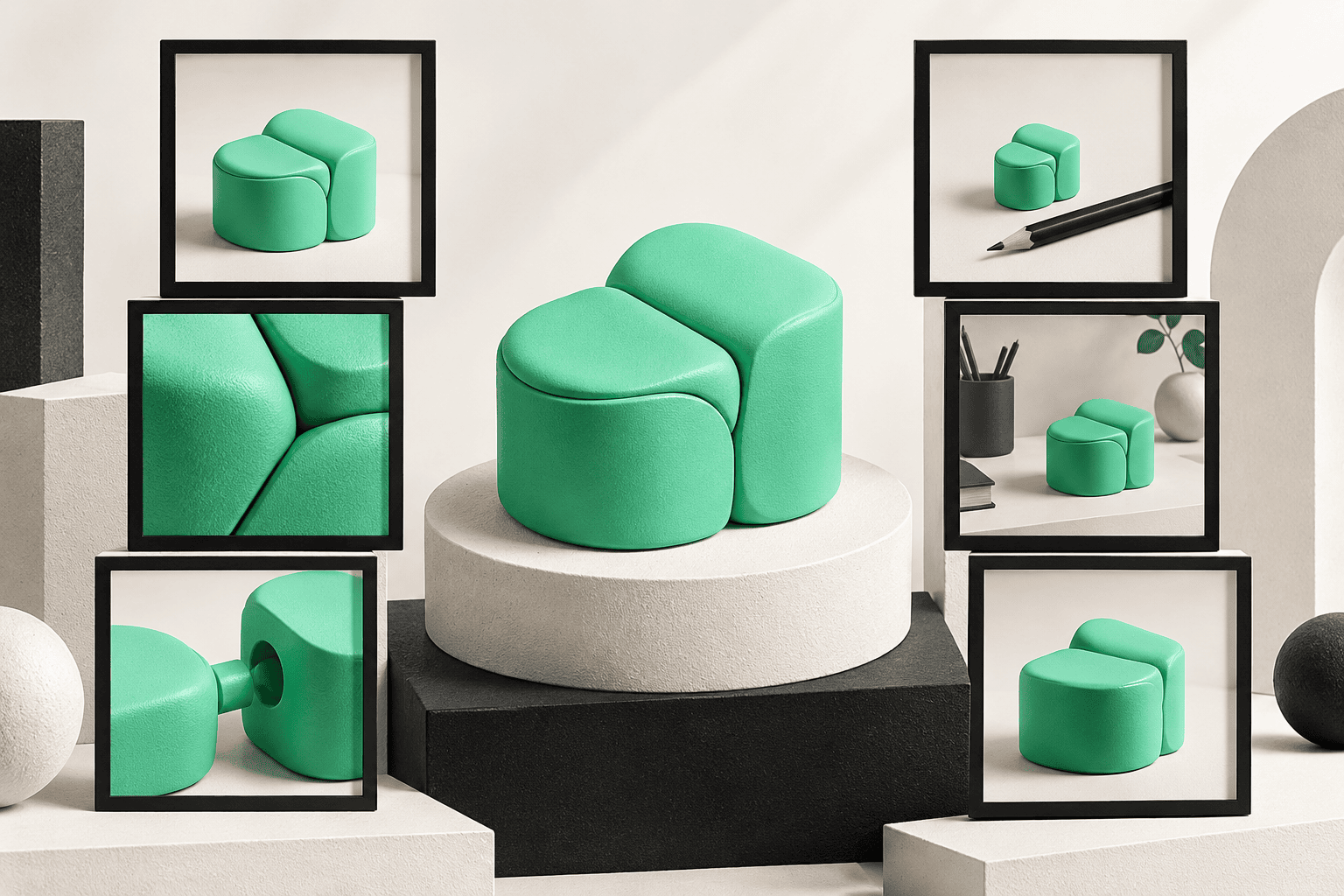
Begin with an accurate hero image that makes the product easy to identify. Follow with scale, detail, use, included components and an in-context scene. Adapt the sequence to the category rather than treating it as a rigid template.
For the travel bag, that might mean a clean front view, an image beside a person, a close-up of the zipper, a packing demonstration, the included strap and a realistic commuting scene.
Use the actual product and relevant variation. If color, size or accessories differ, make that clear. Keep lighting and retouching faithful to important characteristics. An attractive image becomes counterproductive when it creates an expectation the delivered item cannot meet.
Provide enough context for someone who encounters a single image outside the full gallery. Where a detail matters, connect the visual to a concise, accurate explanation.
Let short video demonstrate one thing
A product video does not need to reenact the entire customer journey. Choose a task that benefits from movement: opening, assembling, adjusting, applying or comparing.
Show the action at a useful pace. Avoid edits that make a difficult process appear effortless or conceal a necessary step. If the demonstration uses a particular condition, accessory or technique, disclose it clearly.
Consider silent viewing and small screens. Captions and framing should keep the essential information available. A visual claim must be as accurate as a written one; a dramatic transition is not permission to imply an unsupported result.
Capture still frames and alternate crops intentionally. Repurposing works better when the original production anticipates the placements it must serve.
Keep the promise consistent from ad to product page
If an ad emphasizes compact size, the destination should make dimensions and capacity easy to find. If the campaign features a particular color, do not send the shopper to a confusing default variation without explanation.
Keep names, prices, stock information and offer terms aligned wherever they appear. A story can feel coherent visually while contradicting itself commercially.
Review the mobile experience at realistic speed. Can someone find the delivery information, return conditions and product details without hunting through unrelated content? Is the primary action clear? Are useful descriptions available alongside the imagery?
These questions do not require abandoning personality. They make room for personality by reducing the uncertainty that distracts from it.
Separate aspiration from evidence
Lifestyle imagery helps a shopper imagine ownership. Product evidence helps them decide whether ownership makes sense. Give both a clear role.
Do not present an AI-generated lifestyle scene as documentary proof of a product’s use or performance. Do not invent customer quotations, reviews or before-and-after results. When a visual is illustrative, ensure the context does not mislead.
HalfGenius’s Ani White Cosmetics portfolio documents brand launch, photography and digital marketing work. That combination illustrates why product identity and content should be considered together, while specific performance claims still require their own evidence.
Review the story after the sale
Look beyond clicks and purchases when evaluating creative. Review recurring product questions, return reasons and comments about expectation gaps. Those signals can reveal a missing image or an unclear description.
Avoid assigning every return to creative; fit, fulfillment, quality and customer circumstances also matter. Use the evidence to investigate where the product story could be more accurate or useful.
Before the next campaign, choose one important hesitation and build a focused asset set around it. HalfGenius’s Video + Content services can support photography, production and digital ad creative. Talk with Team Genius about making the product easier to understand, remember and choose.
YOUR NEXT BIG IDEA
Let’s make it happen.
Tell us what you’re working on. We’ll help you find the right next step.